How to successfully launch a B2B product in the United States

The largest market for B2B technology, and the most crowded. For East Asian and European companies choosing a first customer and a way in.

Tell me about your launch

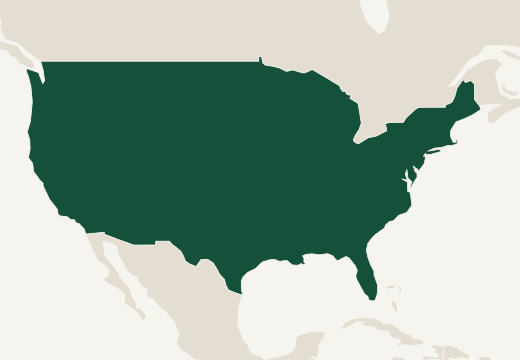
Map of the United States highlighted

Which segment first?

Start with one segment, not one city. The US is a single country for language and currency, and you can sell across it remotely. What you narrow is the customer.

One industry

Choose it if your product is clearly better there than the US alternatives.

Read more

US buyers compare you with well-funded local competitors. A segment where you have a clear edge gives you a winnable first fight and your first US references.

One size of company

Choose it if your product and your price fit the way they buy.

Read more

Enterprise, mid-market and small business buy in different ways, at different price points and through different routes. Pick the one you can serve today.

One problem

Choose it if it is the problem you solve best.

Read more

US positioning rewards a sharp claim: the outcome, the difference and the proof, stated plainly. Once the first segment is repeatable, widen from it.

Where to be

Choose it for your first people, not your first customers.

Read more

Location matters for where you hire and where you support from. Choose it for closeness to your customers and for time zone overlap with headquarters.

Why launches fail here

Underestimating the crowd. In most categories there are well-funded US competitors with louder marketing. Being good is not enough to be noticed.

Positioning that is too modest or too technical. US buyers expect a clear statement of the outcome and why you are different.

Relying on home references. A leading customer in Japan, Korea or Germany means little to a buyer in Chicago.

Pricing too low. A price set for the home market signals a weaker product and leaves no room for US sales and marketing costs.

Having no US presence. Buyers ask for support in their time zone, contracts under US law and security reports such as SOC 2.

What you need before you sell

  1. A narrow first customer
  2. Positioning in US terms
  3. A product that reads as native
  4. US pricing
  5. Proof US buyers accept
  6. A route to market
  7. A launch plan with a test for whether it is working

How I can help

I do that work for your product: the research, the target customer, the positioning and messaging, the UI and UX review, the pricing, the choice of channels and partners, and the launch plan. I can manage the launch, and at launch you get a handover that sets your team up to grow.

I spent more than ten years inside Google, a US technology company, and have worked with US technology companies since 2018. I live in Taipei, so I work in your time zone if you are in East Asia.

  1. 1Market research
  2. 2Target customer
  3. 3Positioning and messaging
  4. 4UI and UX localisation
  5. 5Pricing
  6. 6Channels and partners
  7. 7Launch plan
  8. 8Team definition
  9. Launch
  10. 9Handover

See how it works

Common questions

How does an Asian or European company enter the US market?

Choose one narrow customer segment, rebuild the positioning in the terms US buyers use, set US pricing, get the first US reference customers and put support and sales coverage in US hours. Then widen from that segment.

Do we need a US company to sell in the US?

Not always for first sales, but many enterprise buyers and investors expect a US entity, and it simplifies contracts and payments. Take legal and tax advice.

Do we need to change the product for the US?

Usually less than for other markets, but it matters. Natural English, US date and number formats, the integrations US customers use, and security reports such as SOC 2 are common requirements.

How long does it take to get traction in the US?

Sales cycles are often shorter than in Europe or Japan, but getting noticed takes longer than companies expect. Plan for 9 to 18 months to reach repeatable sales.

Can you introduce us to US customers or investors?

No. You get the target customers, the positioning and the plan. Your team builds the relationships.

All questions → FAQ

In depth: What an international expansion advisor does · Launching in Europe instead

Planning a launch?

Tell me the product and the country. I'll tell you straight whether I can help.

Tell me about your launch